


close
Choose Your Site
Global
Social Media


Views: 0 Author: Site Editor Publish Time: 2026-10-28 Origin: Site


Traditional manual mopping is notoriously slow. It leaves floors dangerously wet, creating severe slip-and-fall hazards for both employees and patrons. Beyond the immediate safety risks, a standard mop merely pushes dirty water around rather than extracting deep-seated grime. Every facility—whether a bustling retail storefront, a sterile hospital wing, or a sprawling logistics warehouse—has highly specific floor maintenance requirements based on layout and surface material. Relying on outdated or incorrectly sized equipment inevitably leads to wasted budgets, operator exhaustion, and subpar hygiene standards.
Transitioning to mechanized cleaning is a crucial step for modern facility management. In this comprehensive guide, you will discover exactly how to evaluate your space and select the perfect Floor Scrubber to dramatically improve your daily maintenance routine.
Assess Square Footage: Walk-behind units are highly effective for facilities ranging from 10,000 to 50,000 square feet.
Drive Type Matters: Facilities with inclines or larger spaces benefit greatly from self-propelled models, which minimize physical strain compared to pad-assist units.
Brush Selection: Matching your scrub head to your specific flooring material is critical for optimal sanitation without surface damage.
Power Source: Battery-operated machines provide superior mobility, while corded units offer continuous runtime for smaller, obstacle-free environments.
Prioritize Maintenance: Selecting machines with accessible recovery tanks and easy-to-change squeegee blades will significantly extend your equipment's operational lifespan.
Recent market analyses indicate a massive shift toward sustainable, data-driven facility maintenance. Procurement officers are increasingly moving away from basic manual tools toward mechanized solutions that emphasize ergonomic safety and resource conservation. Industry trends highlight a growing demand for machines equipped with smart water-saving technologies and noise-reduction features. Furthermore, the rapid adoption of lithium-ion battery technology is transforming operational shifts, allowing for opportunity charging and zero-maintenance power systems. To align with these modern commercial standards, evaluating mechanical efficiency and sustainability features is now a mandatory step in the procurement process.
A walk-behind unit is an industrial-grade cleaning apparatus engineered to automate the tedious process of floor maintenance. Unlike manual methods that require sweeping, applying chemicals, scrubbing, and drying in separate stages, this machine executes all these functions simultaneously. As the operator guides the unit forward, a computer-controlled solenoid valve dispenses a precise mixture of water and cleaning detergent. Motorized brushes aggressively agitate the floor surface, and a high-performance vacuum system immediately extracts the soiled liquid into a dedicated recovery tank.
Picture a busy hospital corridor at midday. Instead of cordoning off large sections with yellow caution signs and waiting hours for the floor to air-dry, a custodian smoothly guides a mechanized scrubber through the hall. The machine leaves a pristine, bone-dry path in its wake, allowing immediate and safe foot traffic. Specifically, this upgrade completely eliminates the thin film of grime and chemical residue traditionally left behind by mop buckets.
Because of their compact footprint and precise maneuverability, these machines are indispensable across various commercial sectors. They are the standard choice for healthcare facilities requiring strict infection control, supermarkets needing spotless aisles, fitness centers battling sweat and scuff marks, and educational institutions managing heavy daily foot traffic.
Before diving into specific technical features, facility managers must first confirm that a walk-behind unit aligns with their building's architectural footprint. Procuring an improperly sized machine can lead to severely bottlenecked productivity or an outright inability to navigate the premises.
Walk-behind models are generally the most efficient choice for buildings with cleanable floor areas under 50,000 square feet. Their primary advantage lies in agility. If your daily cleaning route features narrow storage aisles, sharp corners, congested checkout lanes, or highly populated lobbies, this category offers the granular control necessary to clean thoroughly without damaging adjacent shelving. Economically, they require a lower upfront capital investment compared to their ride-on counterparts and consume significantly less storage space in crowded janitorial closets.
In contrast, ride-on scrubbers are purposely built for massive, wide-open expanses exceeding 50,000 square feet. Think large distribution centers, airplane hangars, or expansive shopping malls. The main benefit here is the drastic reduction of physical fatigue during multi-hour cleaning shifts, as the operator remains comfortably seated. While they boast wider cleaning paths and massive solution tanks for high-speed productivity, they lack the nimbleness of walk-behind units, represent a much steeper initial cost, and demand specialized mechanical upkeep.
Once you have settled on the walk-behind category, the next major operational decision involves the drive system. This mechanism dictates how the machine travels across your floors, directly impacting user ergonomics and overall shift efficiency.
Pad-assist machines rely on the friction generated by the rotating scrubbing pad against the floor to help pull the unit forward. The operator must physically push the machine to maintain a steady walking pace and steer it along the route.
These models are highly budget-friendly, making them an excellent entry-level option for small businesses. Lacking a complex, independent drive motor means fewer internal moving parts, which generally translates to lower long-term maintenance costs and simpler repairs. However, the most significant drawback is user fatigue. Pushing a heavy, water-laden machine requires sustained physical effort. This becomes a glaring issue if your facility features loading ramps, subtle inclines, or highly textured concrete that resists the machine's forward momentum.
For demanding environments, a Self-Propelled Scrubber integrates a dedicated, independent motor connected directly to the wheels. This transaxle propels the machine both forward and backward, meaning the custodian merely needs to guide the steering wheel rather than muscle the equipment around.
The absolute elimination of pushing fatigue is a game-changer for maintaining high productivity during long shifts. These units effortlessly conquer inclines and ramps. Moreover, the traction drive ensures a consistent, even travel speed, resulting in uniform soil removal across the entire facility. They are also inherently safer to operate when managing larger, heavier machines equipped with high-capacity water tanks. The resulting labor savings and consistent daily performance easily justify the premium investment.
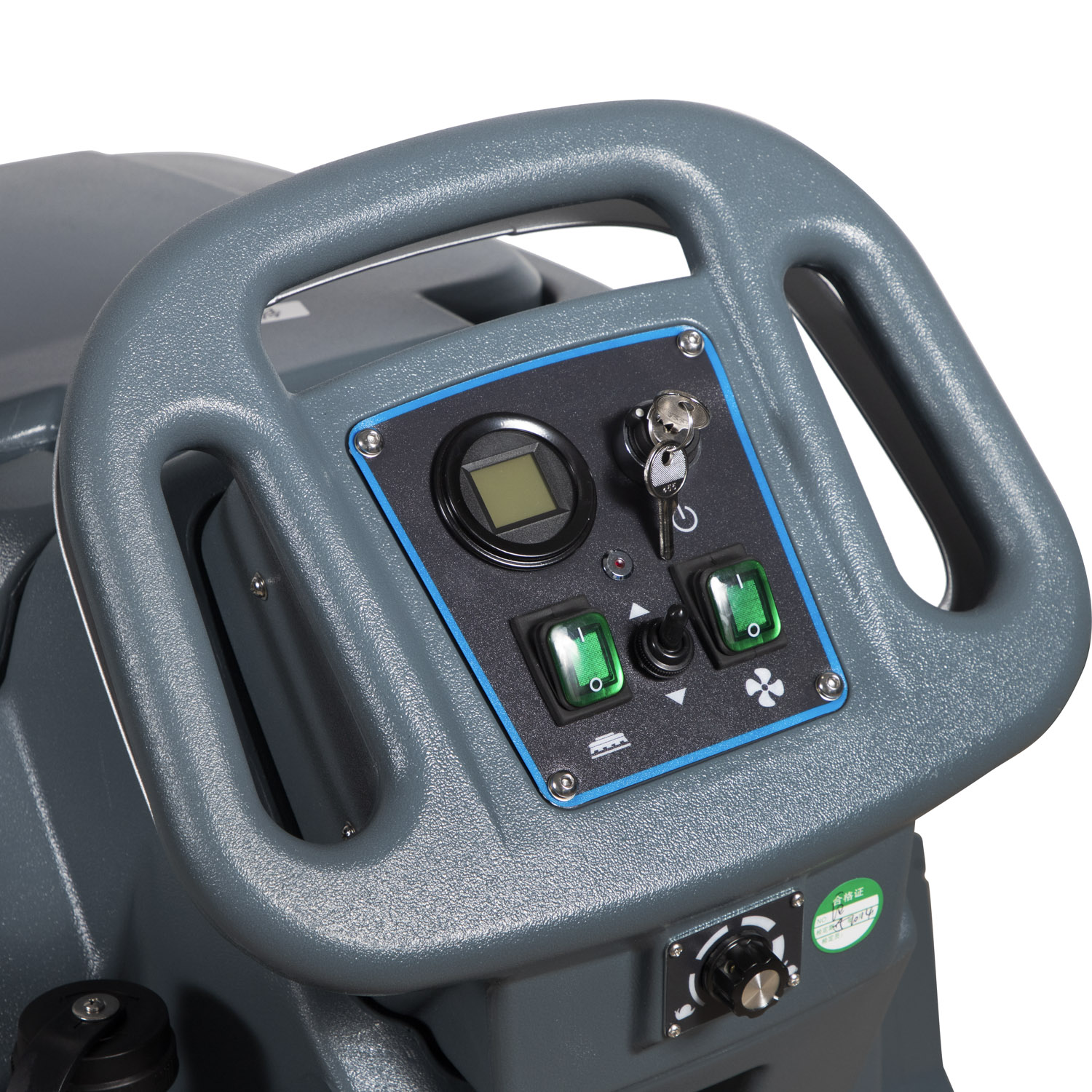
To align with modern engineering standards, evaluating the following mechanical factors is essential. Moving away from abstract concepts, you must look at real-world specifications to ensure the machine can handle your specific workload.
The cleaning path width dictates how much surface area the machine tackles in a single pass. Take professional-grade equipment like the Kuer H75 as an engineering benchmark. It features a dual-brush 750mm scrubbing path—roughly 30 inches—allowing it to cover up to 4,500 square meters per hour. While it is tempting to purchase the widest deck available, practicality must dictate your choice. You must physically measure the narrowest choke points in your building, including tight aisles and standard doorways. The objective is to secure the widest possible path that can still freely navigate your most congested zones.
Industrial scrubbers utilize a dual-tank system. Tank volume directly influences workflow. Larger tanks allow the operator to spend more time actively cleaning and less time walking back to the janitorial closet for dumping and refilling. Look for high-capacity setups. A 75-liter solution tank paired with an 85-liter recovery tank ensures extended cleaning cycles without constant disruption. Aim to harmonize tank capacity with battery runtime to maximize shift efficiency.
The power supply dictates the equipment's geographical range and operational flexibility. Battery-powered units represent the industry standard for modern commercial applications. Standard setups often utilize robust 24V 100Ah battery banks. They offer unmatched freedom, allowing staff to clean anywhere without hunting for wall outlets. Crucially, they eliminate the severe trip hazard caused by trailing extension cords. Conversely, corded electric models are strictly recommended for small, obstacle-free environments where maintenance occurs after business hours.
While the brushes loosen the dirt, the squeegee and vacuum system extract it. If a machine leaves streaks of dirty water behind, it entirely defeats the purpose of mechanized cleaning. Pay close attention to the squeegee assembly. Heavy-duty die-cast aluminum squeegees, typically around 900mm wide, are vastly superior to cheap plastic alternatives. A curved parabolic design channels water directly into the center vacuum hose and tracks flawlessly behind the machine during sharp turns. Concurrently, verify the vacuum motor's water lift rating to guarantee bone-dry floors.
Procuring a high-quality machine is only half the battle. It must be configured correctly for your specific flooring material to prevent catastrophic damage and ensure pristine cleanliness. Facility managers must evaluate the porosity, finish, and typical debris profile of their surfaces.
Industrial concrete and epoxy-coated surfaces are built to withstand heavy forklift traffic and heavy machinery. Consequently, they frequently accumulate stubborn tire marks, petroleum spills, and embedded metallic dust. To effectively remediate these spaces, facility managers should seek machines capable of applying immense downward brush pressure. Aggressive grit brushes are typically required to break down heavy grease on unfinished concrete. Additionally, facilities dealing with oily environments must opt for polyurethane or Linatex squeegee blades, as standard gum rubber will degrade rapidly when exposed to industrial solvents.
Vinyl Composition Tile remains the ubiquitous flooring choice in healthcare and educational settings. These floors are almost universally treated with layers of acrylic wax to maintain a high-gloss, professional aesthetic. The primary objective here is to lift surface dirt without scratching or stripping away the expensive protective coating. A disc-style machine paired with soft, non-abrasive floor pads is mandatory. High brush pressure is detrimental; instead, consistent rotation combined with a neutral pH cleaner yields the best results.
Facility Floor Type | Recommended Scrub Head | Ideal Brush or Pad Material | Recommended Squeegee Blade |
|---|---|---|---|
Unfinished Concrete | Disc or Cylindrical | Grit Brush or Heavy Poly | Linatex Tear Resistant |
Polished Concrete or Epoxy | Disc | Medium Nylon Brush | Polyurethane Oil Resistant |
Waxed VCT | Disc or Orbital | Red Pad or Soft Nylon | Gum Rubber Smooth surfaces |
Tile and Grout | Cylindrical | Medium Stiff Nylon Brush | Polyurethane |
For business owners and procurement officers, upgrading to mechanized cleaning equipment is a significant capital expenditure that must be justified through a clear Return on Investment. While the initial acquisition cost may seem substantial, the operational savings generated by a dedicated machine typically yield a full financial return within six to twelve months.
Labor is universally the most expensive line item in any facility maintenance budget, often comprising up to 80 percent of total cleaning costs. Manual mopping is astonishingly inefficient. A custodian using a standard mop can cover approximately 4,000 square feet per hour. In stark contrast, a professional 30-inch machine can effectively scrub and dry up to 45,000 square feet in that exact same timeframe. By saving several hours of manual labor daily, management can reallocate janitorial staff to higher-value tasks, effectively lowering the overall labor burden.
Slip-and-fall accidents present a massive liability. According to industry safety data, the average cost of a slip-and-fall worker compensation claim or customer lawsuit can easily exceed tens of thousands of dollars. Because mechanized scrubbers extract dirty water immediately, floors are left bone-dry and safe. Mitigating just one potential lawsuit often pays for the machine entirely. Furthermore, the consistent removal of abrasive dirt prevents premature wear on the flooring material itself, delaying the massive capital expense of a facility-wide floor replacement.
Identifying the right technical specifications is only half the process. Selecting a reputable equipment supplier is equally critical. These machines operate in harsh environments and endure rigorous daily wear, meaning your relationship with the manufacturer will extend far beyond the initial invoice. Prioritize manufacturers that offer transparent, robust warranties covering both parts and labor.
For facilities ready to make a data-driven upgrade to their maintenance protocols, investing in a reliable Commercial Floor Scrubber from a trusted manufacturer ensures long-term operational success. Reputable providers like Kuer Clean focus on heavy-duty construction, intuitive operator controls, and high-capacity recovery systems designed specifically for industrial use. By choosing a supplier with a proven track record, you ensure that your investment is protected by reliable customer service and accessible aftermarket solutions. Evaluate your facility dimensions today, review the technical specifications of top-tier models, and take a decisive step toward a safer, more efficient building.
The runtime of a battery-operated unit depends heavily on the battery chemistry and the friction of the floor surface. Standard Lead-Acid or Absorbent Glass Mat batteries typically provide between two to four hours of continuous runtime on a single charge. Modern machines equipped with Lithium-ion batteries can run longer, charge significantly faster, and allow for opportunity charging—plugging the machine in for short periods during breaks without damaging the battery memory.
For unfinished or heavily soiled concrete, a machine with high downward brush pressure and a cylindrical scrub head is often best, as it can sweep up small debris while scrubbing. You will want to equip it with aggressive grit brushes to break through grease and oil. Additionally, ensure the machine is fitted with oil-resistant polyurethane or Linatex squeegee blades, as standard gum rubber will quickly deteriorate on rough, oily concrete.
Standard disc and orbital scrubbers cannot sweep. If you use a disc machine, the floor must be thoroughly swept or dust-mopped beforehand; otherwise, large debris will clog the squeegee vacuum hose or get dragged around, severely scratching the floor. However, if you purchase a machine equipped with a cylindrical brush head, it can perform both tasks simultaneously. Cylindrical brushes rotate at high speeds to sweep small, loose debris such as screws, pebbles, or wood chips into a dedicated hopper while dispensing solution and scrubbing the floor.
Routine daily maintenance is not difficult but is absolutely critical to prevent premature machine failure. The most important daily tasks include draining and thoroughly rinsing the dirty water recovery tank to prevent sludge buildup and foul odors. Operators must also wipe down the squeegee blades, clear debris from the vacuum hose, and rinse the scrub brushes. Finally, ensuring the batteries are properly charged after the shift is essential for extending the electrical lifespan of the unit.
With rigorous daily maintenance, routine preventative servicing, and timely replacement of wear parts such as brushes and squeegees, a high-quality commercial machine will reliably serve a facility for seven to ten years. In the commercial cleaning industry, lifespan is often measured in run-hours rather than calendar years. A well-built unit is generally expected to operate efficiently for 2,000 to 3,000 hours before major internal components, such as the vacuum motor or transaxle, may require complete replacement or rebuilding.


