


close
Choose Your Site
Global
Social Media
Views: 0
In factories and workshops, the real challenge in cleaning heavily soiled oily floors isn't the "dirt," but the "grease" Machine oil, cutting fluid, and grease left over from daily work, once spread out, require repeated cleaning with traditional manual mops to clean even a small area. This is not only inefficient but also makes the floor increasingly slippery and prone to slipping.
The core advantage of using industrial floor scrubbers is that they complete brushing, washing, and vacuuming in one operation. Heavy-duty floor scrubbers suitable for oily floors are equipped with adjustable brush pressure systems, allowing the machine to use different pressures to scrub oily surfaces such as epoxy and concerte floors, effectively protecting the floor and extending its lifespan.
The working principle of heavy-duty industrial floor scrubbers is similar to that of ordinary floor scrubbers. The biggest difference lies in the fact that heavy-duty industrial floor scrubbers are generally equipped with a brush pressure adjustment system. When dealing with heavily soiled oily floors, a neutral oil-removing cleaner can be added to the scrubber's clean water tank. Then, the brush pressure is increased, utilizing the high pressure and high-speed rotation of the brush to continuously break down the oil stains, achieving a deep clean. Furthermore, after cleaning, the machine's high-powered wastewater recovery system effectively collects the wastewater into the wastewater tank, allowing the floor to dry quickly and reducing the risk of slipping.
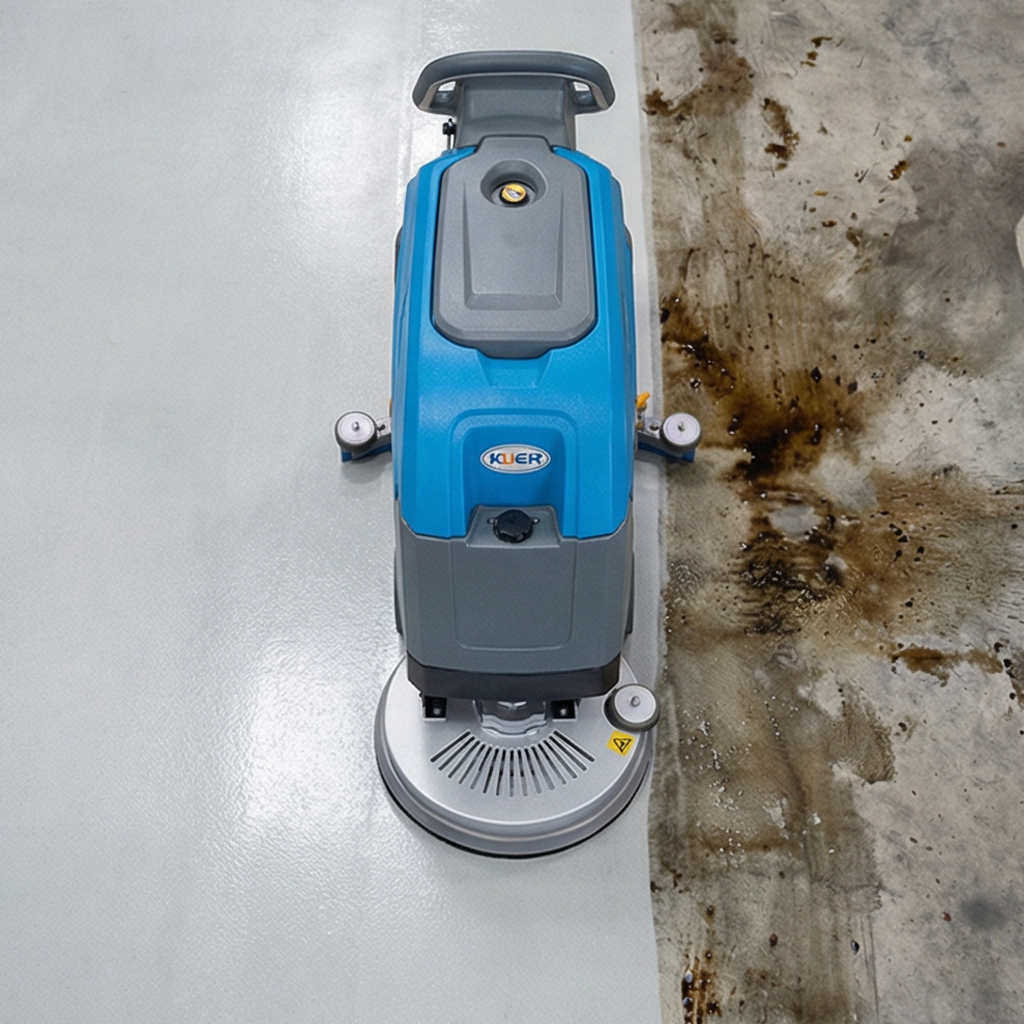
Many commercial and industrial floor scrubbers on the market are labeled as suitable for oily floors, but as a buyer, the best choice is the one that suits your specific needs. For a savvy buyer, the following points should be considered when choosing a floor scrubber for oily floors:
When selecting a floor scrubber for oil removal, the brush pressure, brush speed, and squeegee design are crucial. Sufficient brush pressure and stable speed are essential for effectively removing oil and achieving deep cleaning. The vacuum motor and squeegee should also have good sealing to ensure the floor dries quickly after washing, preventing secondary contamination.
For cleaning heavy oil stains, industrial floor scrubbers must be waterproof, oil-proof, corrosion-resistant, and have non-slip tires. Critical components such as the wiring and motor need adequate protection to prevent malfunctions due to oil splashes during prolonged cleaning. Oily surfaces are slippery, so non-slip tire design is also vital. Whether ride-on or push-mounted, choose a model with a stable, corrosion-resistant chassis and non-slip tires to ensure smooth and safe cleaning and reduce the risk of operator slipping.
Many machines on the market can achieve the above points, with major brands like Kärcher having a clear advantage, but their prices may be relatively high. For buyers with limited budgets, choosing a manufacturer with good quality, reasonable prices, and comprehensive after-sales service is crucial. Here, we recommend KUER commercial floor scrubbers. All KUER floor scrubbers use automotive electrophoresis chassis, and their wiring harnesses all use industrial-grade oil-resistant and waterproof protective sleeves. Key parts of the machine are also reinforced with rubber sleeves or corrugated pipes, ensuring stable operation on oily surfaces over long periods.
For example, the KUER A65 walk-behind floor scrubber features waterproof connectors and oil-resistant sleeves for its main control harness, motor harness, and sensor harness, making it suitable for various small to medium-sized oily areas. For larger areas, we recommend the KUER-XJ70S ride-on floor scrubber. The entire vehicle uses integrated wiring harnesses, a fully sealed, oil-resistant design, and can meet the continuous operation needs of large workshops and factories.


