


close
Choose Your Site
Global
Social Media


Views: 0 Author: Site Editor Publish Time: 2026-10-07 Origin: Site


Are high labor costs draining your facility maintenance budget? Manual sweeping simply takes too long for expansive spaces. Meanwhile, massive ride-on scrubbers often get stuck in narrow factory aisles. A walk-behind floor sweeper fills this operational gap perfectly. It combines heavy-duty industrial cleaning power with precise maneuverability. What exactly can these machines handle? Where do they perform best? Let us break down the engineering behind these units and how to spec the right model for your specific commercial site.
Versatility: Effortlessly transition from smooth indoor factory concrete to rough outdoor parking lot asphalt.
Maneuverability: Navigate congested production lines and tight garage ramps where bulky ride-on machines cannot fit.
Safety & Compliance: Guarantee zero emissions for superior indoor air quality, meeting strict OSHA dust control mandates.
Cost Efficiency: Drastically reduce labor hours compared to manual brooms. This delivers a rapid, measurable return on investment.
Recent shifts in industrial facility management point heavily toward electrification and automation. Stricter environmental regulations and corporate sustainability targets are pushing plants away from gas-powered gear. Facility managers now demand equipment that reduces carbon footprints without sacrificing torque. Before investing, procurement teams must grasp the mechanical principles driving this efficiency. These machines automate debris collection, replacing exhausting broom work with motorized precision.
How do these machines actually capture dirt? The secret lies in a synchronized dual-brush system paired with active vacuum filtration. First, the rotating side brushes act as aggressive edge-cleaners. They extend beyond the machine's primary footprint. This allows them to pull debris away from baseboards, machinery edges, and pallet racks, funneling everything directly into the center path.
Next, the main cylindrical sweeping brush takes over. Spinning at high RPMs, it lifts heavy gravel and metal shavings, launching them into the onboard collection hopper. Simultaneously, an integrated vacuum fan pulls airborne dust through a high-efficiency panel filter. Microscopic particles stay trapped inside the machine. This protects product inventory and keeps the air safe for workers. Advanced models often feature sweeping widths exceeding 1000mm, ensuring maximum coverage per pass.
Factory layouts are rarely wide open spaces. You have intricate production lines, support columns, and parked vehicles. The main benefit here is the minimal footprint. Because the operator walks directly behind the unit, the turning radius remains incredibly tight. Consequently, a Compact Sweeper pivots seamlessly in cramped aisles. It reaches neglected corners safely and avoids the collision risks that plague oversized ride-on alternatives.
Industrial zones generate a chaotic mix of waste. A reliable sweeping solution must handle varying debris profiles without constantly jamming or requiring manual intervention.
Processing lumber, cement, or plastics creates chronic dust hazards. Pushing a standard broom through cement dust just kicks particles into the air. This coats machinery and creates severe inhalation risks. Motorized units utilize active dust control. By combining heavy-duty filters with automated filter shakers, they trap fine powders securely inside the hopper.
Factory floors also collect dense, abrasive trash. You need durable bristles and reinforced hoppers for tough refuse. Operators can quickly clear jagged pallet splinters, sharp CNC metal shavings, and loose screws. The mechanical lift handles these dense materials effortlessly, eliminating the danger of picking up sharp objects with a manual dustpan.
Modern manufacturing optimizes every square inch of floor space. Aisles are narrow and constantly busy with forklifts and personnel. The agility of a walk-behind unit is invaluable here. Operators maintain clear forward visibility. They can guide the machine right up to active workstations without disrupting the ongoing workflow.
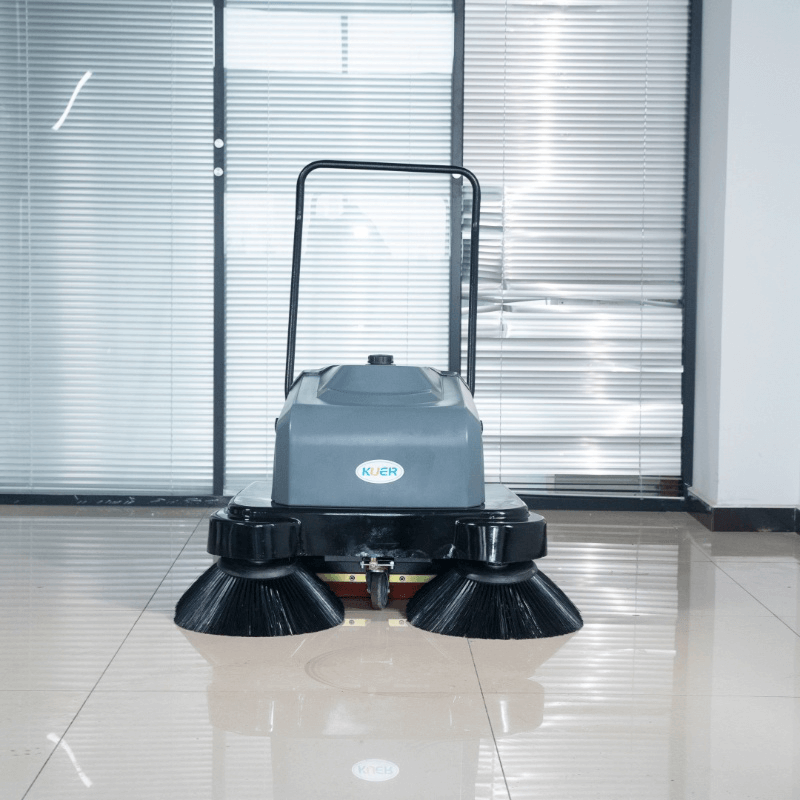
Furthermore, these machines are not limited to indoor use. They easily manage the harsh conditions of outdoor parking lots and multi-level garages.
Outdoor asphalt takes a beating from weather and traffic. A premium Commercial Floor Sweeper features adjustable brush pressure. Operators can lower the main broom to agitate uneven surfaces effectively. This extracts wet autumn leaves, tire-tracked gravel, and everyday litter like coffee cups. Keeping these areas clean prevents clogged storm drains and maintains a professional exterior.
Multi-level garages trap winter salt, street mud, and corrosive moisture. When minor vehicle leaks occur, maintenance teams use oil absorbent powders. Sweeping up saturated oil dry with a manual broom is frustrating and ineffective. Motorized sweepers provide the torque to extract compacted grime from porous concrete. Built-in traction drive systems also help them navigate steep garage ramps safely.
Operating machinery around moving cars requires strict safety measures. Walking behind the unit gives the operator excellent situational awareness. They can stop instantly if a pedestrian steps out or a car reverses unexpectedly. High-visibility safety coloring ensures the machine is easily seen in dimly lit garage corners.
The power source dictates where you can safely clean. For indoor applications, battery technology is the uncompromising standard.
Gas or propane engines emit harmful carbon monoxide. Running them indoors violates safety protocols and endangers staff health. A Battery Powered Floor Sweeper eliminates this hazard entirely. They produce zero toxic emissions. This makes them the only legally compliant choice for enclosed manufacturing spaces.
Gas equipment often exceeds 85 decibels, requiring operators to wear ear protection. Battery-powered units run much quieter, usually hovering around 65 to 70 decibels. Crews can clean during active daytime shifts without disrupting warehouse logistics or nearby office communication.
Modern industrial batteries deliver exceptional run times. A standard charge typically yields several hours of continuous operation. High-performance models utilize robust battery banks, allowing operators to cover tens of thousands of square feet on a single charge. This eliminates frustrating mid-shift recharging delays.
Specifying the wrong equipment size drains your budget. Too small, and labor costs spike. Too large, and you waste capital on a machine that cannot fit your aisles. Understanding operational thresholds is vital.
Feature | Walk-Behind Sweeper | Ride-On Sweeper |
|---|---|---|
Ideal Facility Size | 10,000 - 80,000 sq. ft. | 100,000+ sq. ft. |
Maneuverability | Excellent (Navigates tight corners and narrow aisles) | Moderate (Requires a wide turning radius) |
Initial Investment | Low to Moderate | High |
Maintenance Cost | Low (Fewer complex drive parts) | High (Complex electronic drive motors) |
Best Application | Congested factories, standard parking lots, garages | Massive distribution centers, outdoor stadiums |
When spatial configuration matters more than raw speed, the walk-behind is your best bet. It navigates congested zones effortlessly and requires less storage space. Conversely, ride-on machines belong in massive, unobstructed logistics centers where operator fatigue over long distances is the primary concern.
Many facilities still rely on basic push brooms. This practice is a massive hidden drain on operational budgets and a liability for workplace health.
Equipment is cheap; labor is expensive. A worker with a push broom cleans about 3,000 square feet per hour. A motorized unit easily clears up to 30,000 square feet per hour. That is ten times the speed. If a large floor is swept three times a week, manual labor costs tens of thousands of dollars annually. The labor savings alone usually pay for the machine within the first few months.
Push brooms merely move dirt around. They agitate hazardous particulate matter into the air. This airborne dust settles on expensive manufacturing equipment and creates respiratory hazards. Motorized units solve this with active vacuum filtration, ensuring a genuinely clean and safe environment.
Not all machines are built to withstand industrial abuse. When upgrading, look for specific engineering details to ensure longevity and efficiency.
The hopper is your debris bin. An undersized bin forces constant trips to the dumpster, killing your productivity. Look for models boasting a 50L capacity or higher to maximize continuous sweeping time. Ergonomic handles are also crucial for safely dumping heavy metal scrap without straining the operator's back.
Factory concrete is smooth, while outdoor asphalt is rough. Adjustable downward brush pressure is non-negotiable. Lower it indoors to save battery and bristle life. Increase it outdoors to dig into asphalt cracks and extract compacted dirt.
Industrial environments are brutal. Machines will inevitably bump into steel racks and concrete pillars. Avoid brittle plastic chassis. Prioritize robust steel frames and impact-resistant polyethylene shells. Breakaway side brush brackets are also a sign of smart engineering, protecting the motors from direct curb impacts.
A reliable walk-behind unit bridges the gap between indoor precision and outdoor ruggedness. Ditching the manual broom slashes labor costs and boosts facility safety. Ready to optimize your maintenance routine? Explore high-quality sweeping solutions from KUER today to find the exact specifications your commercial space demands.
Yes. A high-quality commercial sweeper equipped with strong downward brush pressure and an impact-resistant hopper easily handles heavy industrial debris. It lifts metal shavings, loose screws, and wood splinters efficiently without damaging internal components.
Absolutely. While their zero-emission profile makes them perfect for indoors, they are highly effective outdoors. On dry days, these machines excel at sweeping up seasonal leaves, loose gravel, and everyday litter from expansive parking lots.
A motorized unit cleans up to 30,000 square feet in a single hour. This makes it roughly ten times faster than a worker relying on a standard manual push broom. It allows you to reallocate labor hours to more valuable tasks.
Routine maintenance is straightforward. Operators should empty the debris hopper after each shift, shake out the dust filter, and visually inspect the brushes. Removing tangled debris like shrink wrap or string keeps the motors running smoothly.
Depending on the battery chemistry, a full charge typically provides 3 to 5 hours of continuous run time. This robust capacity is usually more than enough to cover standard commercial maintenance routes without needing a mid-shift recharge.
While they are primarily designed for dry debris like dust, gravel, and leaves, many machines can handle slightly damp surfaces. However, they do not have squeegees or water recovery tanks, so they should not be used to suck up standing water like a floor scrubber.


