


close
Choose Your Site
Global
Social Media


Views: 0 Author: Site Editor Publish Time: 2026-10-21 Origin: Site


Managing an expansive warehouse means fighting a daily battle. Dust, debris, and stubborn forklift tire marks accumulate relentlessly. Maintaining a pristine floor in high-traffic logistics hubs is not merely about aesthetics. It is a strict safety and operational requirement. However, floor cleaning should never become a bottleneck that disrupts your core operations.
Procuring an undersized machine triggers a frustrating cycle. Operators constantly stop for water refills and battery charging. This drains valuable labor hours. Conversely, investing in an oversized unit wastes capital. It also creates maneuverability nightmares in dense storage aisles. Finding the exact sweet spot in tank capacity and battery runtime is the ultimate key to maximizing your cleaning efficiency.
This comprehensive engineering guide breaks down exactly how to calculate the optimal tank size and battery life for your facility. We will ensure your warehouse remains spotless while delivering a maximum return on investment.
Match Size to Space: A standard large warehouse ranging from 50,000 to 100,000 square feet typically requires a machine with a 30 to 40-gallon tank and a runtime of 4 to 6 hours.
Tank Capacity Equals Labor Savings: Larger solution and recovery tanks mean fewer trips to the dumping station. This directly saves on hourly labor costs.
Battery Chemistry Matters: Upgrading to Lithium-ion batteries can double your runtime. It eliminates mid-shift charging compared to traditional lead-acid alternatives.
Calculate by Cleanable Area: Always base your equipment specifications on your facility's cleanable square footage rather than the total architectural footprint.
Advanced Tech Extends Specifications: Modern features like onboard water recycling systems and eco-modes artificially extend both your tank capacity and battery runtime.
Recent market analyses in logistics automation reveal a dramatic shift in facility floor utilization. Driven by the global e-commerce boom, modern fulfillment centers are actively shrinking their storage aisles. They are building racking higher to maximize vertical space. Concurrently, severe labor shortages force facility managers to seek higher productivity per worker.
This operational intensity demands highly efficient crossover equipment. Facilities now require machines that pack the high fluid capacity of heavy-duty models onto a highly maneuverable chassis. Efficiency is no longer measured just by driving speed. It is evaluated by maximizing the volume of water and battery power deployed per square foot without interrupting heavy forklift traffic.
Facility managers must evaluate maintenance equipment based on strict, measurable productivity metrics. When overseeing massive distribution centers or manufacturing plants, the physical limitations of smaller equipment quickly become glaring operational liabilities. Validating the need for a larger sit-down machine requires a close look at cleaning speeds and overall labor utilization.
The primary metric for comparing any commercial cleaning equipment is the square footage covered per hour. A standard walk-behind scrubber typically maxes out at around 15,000 to 20,000 square feet per hour. This pace is adequate for grocery stores or small workshops but falls drastically short in industrial settings. In stark contrast, an Industrial Floor Scrubber designed for ride-on operation can efficiently scrub 30,000 to well over 50,000 square feet per hour.
Beyond raw speed, operator fatigue dictates daily productivity. Pushing a heavy walk-behind unit across a 70,000-square-foot concrete expanse causes significant physical strain. As the shift drags on, the operator's walking speed naturally decreases. Ride-on models eliminate this physical exertion entirely. The operator sits comfortably and maintains a consistent high-speed cleaning pace from the first minute of the shift to the last.
Procurement officers should look for empirical daily friction points. These indicate that current equipment is failing to meet facility demands. It is time to consider an equipment upgrade if you observe the following scenarios on your floor:
Extended Cleaning Routines: Your current floor maintenance schedule spills over and requires more than one full eight-hour shift to complete.
Escalating Labor Costs: The hourly wages allocated specifically for floor maintenance are consuming a disproportionate slice of your operational budget.
Facility Expansion: You are moving into a new building or expanding your current footprint to exceed 30,000 square feet of cleanable space.
Excessive Transit Time: Operators spend an unreasonable amount of time driving back and forth to distant janitorial closets just to empty and refill water tanks.
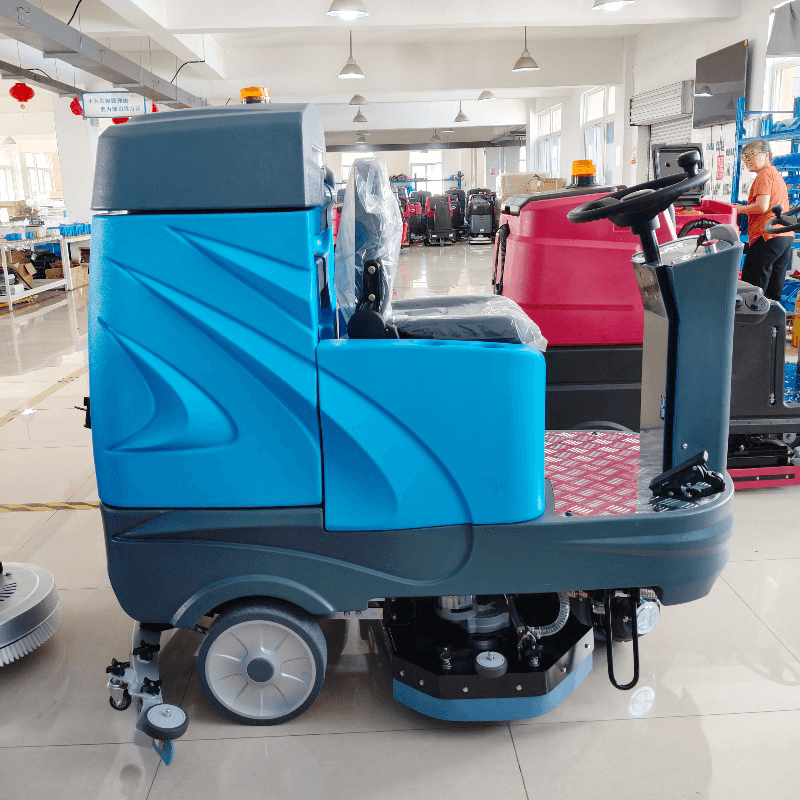
Tank capacity dictates exactly how long an operator can actively clean before they are forced to stop and manage water. Grasping the underlying fluid mechanics of these tanks is crucial. It ensures you select the right Ride On Scrubber Dryer for your specific environment.
Every scrubber operates using a dual-tank ecosystem. The solution tank holds the clean water mixed with your chosen industrial degreasers. As the machine moves forward, this liquid is dispensed onto the floor. Trailing behind the scrub deck, the squeegee and vacuum system immediately extract the dirty liquid. This waste is deposited into the recovery tank.
Furthermore, these two tanks must be volumetrically balanced by the manufacturer. If a recovery tank is designed too small, the machine's internal sensors will shut off the vacuum motor prematurely to prevent overflow. This leaves perfectly good clean water unused in the solution tank. Additionally, recovery tanks must feature wide access points. In a warehouse dealing with heavy dust, a difficult-to-clean recovery tank quickly develops thick sludge buildups. This leads to stagnant odors and harmful bacterial growth.
Capital procurement decisions frequently overlook the recurring hidden labor costs associated with undersized tanks. Consider a practical engineering scenario. An operator is cleaning the far loading dock but runs out of water. They must drive the machine all the way across the warehouse to the janitorial station. They drain the dirty water, flush the tank, refill the clean water, and drive back. This round trip easily consumes 15 to 20 minutes.
If a small tank forces the operator to repeat this process four times per shift, the facility loses a full hour of productive cleaning time every single day. Over a standard 250-day working year, that equates to 250 lost labor hours. At a conservative burdened labor rate of 20 dollars per hour, an undersized tank quietly drains 5,000 dollars annually in wasted wages.
Shifting focus from water capacity to electrical power, battery specifications are equally critical. A machine boasting a massive 60-gallon water tank is effectively useless if its power source dies halfway through the job. Evaluating battery discharge curves ensures your machine possesses the endurance to finish the shift uninterrupted.
A prevalent misconception in facility management is that an eight-hour shift necessitates an eight-hour battery. In reality, continuous runtime differs vastly from overall shift length. Throughout a standard day, operators spend time completing pre-shift safety inspections. They move stray pallets out of aisles, manage chemical inventory, and take mandated breaks.
For large-scale operations, a minimum of 3.5 to 4 hours of continuous scrubbing is the required baseline. Procuring a machine rated for 4 to 6 hours of runtime provides a vital buffer. This extra capacity accounts for heavy soil conditions like thick tire resin. Deep cleaning demands slower driving speeds and maximum brush pressure. Both of these actions drastically increase the amp-hour draw and drain the battery faster.
The internal chemistry of the battery dictates not only the runtime but also the daily maintenance requirements and total lifespan of the power source.
Lead-Acid Wet Cell: The traditional cost-effective standard. They provide reliable power but require strict daily maintenance. This includes weekly watering to prevent the cells from drying out and failing.
Absorbent Glass Mat or AGM: A solid mid-tier option. They cost slightly more upfront but are completely sealed and maintenance-free. This eliminates the safety hazards associated with handling battery acid.
Lithium-Ion: The premium tier. While carrying a higher initial price tag, they offer zero maintenance and the longest continuous runtimes. They also possess the ability to charge rapidly.
Traditional lead-acid batteries demand a rigid charging protocol. They require a full discharge followed by a long uninterrupted 8 to 12-hour charging cycle. Plugging them in for short bursts permanently damages the internal lead plates.
In contrast, lithium-ion technology introduces opportunity charging. Operators can safely plug the machine into the wall during a 30-minute lunch break or a quick 15-minute shift handover. This is done without degrading the battery's lifespan. For logistics centers operating around the clock, this capability is revolutionary. A single machine can service multiple consecutive shifts through strategic opportunity charging. This entirely eliminates the need to purchase a secondary backup scrubber.
To achieve the highest possible return on capital, facility managers must align machine specifications directly with the physical geometry of their building. Guesswork in this phase leads to profound operational inefficiencies. Below is a definitive engineering benchmark guide for matching equipment to warehouse size.
Facility Size Cleanable Area | Recommended Tank Capacity | Ideal Battery Runtime | Target Cleaning Path |
|---|---|---|---|
30,000 to 50,000 Sq Ft | 20 to 30 Gallons | 2.5 to 3.5 Hours | 26 to 28 Inches |
50,000 to 100,000 Sq Ft | 30 to 45 Gallons | 4 to 5 Hours | 28 to 32 Inches |
100,000+ Sq Ft Mega Hubs | 40 to 70+ Gallons | 5 to 6+ Hours | 34 to 40+ Inches |
For massive distribution centers exceeding 100,000 square feet, efficiency is measured in fractions of a cent per square foot. Undersized equipment in these environments results in catastrophic labor waste. Industrial engineering benchmarks point toward high-capacity configurations to solve this.
Specifically, flagship industrial models are engineered for these exact sprawling environments. A prime example is equipment featuring a 150-liter solution tank paired with a 170-liter recovery tank. Combined with an 850mm cleaning width and dual 380W brush motors, this specific configuration allows operators to scrub continuously for up to 5 hours. Deploying parameters like these eliminates mid-shift dumping cycles and maximizes active floor time.
A frequent purchasing error is acquiring equipment based strictly on the architectural footprint of the building. A 100,000-square-foot warehouse does not actually contain 100,000 square feet of cleanable floor. You must meticulously subtract the square footage occupied by permanent racking structures, pallet storage zones, heavy machinery, and office spaces. Often, a massive facility only yields 50,000 square feet of truly cleanable space. This realization drastically alters your required equipment specifications.
Manufacturer specification sheets provide maximum theoretical runtimes tested under pristine laboratory conditions. Real-world logistics environments introduce harsh variables. These variables cause machines to consume water and battery power much faster than advertised.
The physical texture and daily condition of your concrete directly dictate resource consumption. Unsealed porous concrete acts like a giant sponge. It absorbs moisture instantly. To achieve a thorough clean, operators must significantly increase the solution flow rate. This drains the tank rapidly. Similarly, facilities plagued by heavy forklift traffic or industrial grease require maximum water flow and higher chemical concentrations to lift the grime. This cuts effective tank capacity by up to 30 percent.
When operators encounter deeply ingrained dirt, they utilize the dashboard controls to apply maximum downforce. This physically pushes the scrub deck harder against the concrete. While necessary for deep cleaning, this creates immense friction. To overcome this resistance, the brush motors must draw significantly higher amperage from the batteries. Running a machine constantly at maximum downforce can easily reduce a rated 5-hour battery runtime to just over 3 hours.
Modern engineering has introduced brilliant features that help facilities maximize the efficiency of whatever tank and battery size they select. When evaluating a Warehouse Cleaning Machine, look for these specific mechanical innovations.
Advanced onboard water recycling is arguably the most impactful technological leap in floor maintenance. These systems take the dirty extracted water from the recovery tank and force it through a series of complex multi-stage filters. They then return the purified water back to the solution tank for immediate reuse. This technology allows a modest 30-gallon tank to perform with the longevity of a 90-gallon tank. It drastically slashes the frequency of dump-and-refill cycles.
Older machines dispense water at a flat continuous rate regardless of how fast the operator is driving. This leads to massive water waste when the machine slows down to navigate tight corners. Smart dispensing systems link the solution flow rate directly to the accelerator pedal. If the machine slows down, water output decreases proportionately. Combined with dedicated Eco-Modes that dial back vacuum motor power for light-duty cleaning, these features can extend battery and water runtime by up to 20 percent.
For procurement officers, acquiring capital equipment demands strict financial justification. The decision between different tank sizes and battery capacities ultimately boils down to long-term return on investment and total cost of ownership.
As demonstrated earlier, minimizing operator downtime is the absolute fastest way to recoup the capital cost of a machine. By investing slightly more upfront for a larger tank capacity and a high-end Lithium-ion battery, a facility completely eliminates mid-shift charging. It also drastically reduces water refill trips. Reclaiming just 45 minutes of wasted labor per shift translates to thousands of dollars in wage savings annually. In many high-volume facilities, the higher initial purchase price of the correctly sized machine is entirely offset by labor savings within the first 12 to 14 months of operation.
Purchasing an undersized machine simply to save upfront capital is a dangerous false economy. If a compact scrubber engineered for 30,000 square feet is forced to clean an 80,000-square-foot facility every day, its internal components will be pushed far beyond their engineered duty cycles. This relentless overworking leads to premature vacuum motor failure. It degrades battery cells from deep discharging and causes frequent costly downtime. Investing in the correct industrial capacity ensures the machine operates comfortably within its intended limits. This greatly extends the asset's total lifespan.
Selecting the optimal floor cleaning equipment requires meticulous planning and a deep understanding of fluid dynamics and battery efficiency. You must align the machine's tank capacity with your actual cleanable floor space. Simultaneously, you must ensure the battery runtime can support your daily operational shift lengths without causing disruptive downtime.
By accurately calculating your cleanable square footage and taking floor porosity into account, you prevent costly procurement mistakes. You avoid buying an oversized behemoth or an undersized overworked unit. Making smart data-driven choices lowers your daily labor costs. It improves overall facility hygiene and delivers a rapid return on investment.
Before you finalize your procurement budget, carefully evaluate your warehouse layout. When you are ready to upgrade your facility's maintenance protocol, explore high-efficiency durable options. Find the perfect Ride On Floor Scrubber engineered specifically for your large-scale logistical needs at KUER Clean.
Charging times depend entirely on the specific battery chemistry housed within the machine. Standard lead-acid wet cell batteries typically require a long uninterrupted 8 to 12 hours to reach a full charge. This is followed by a mandatory cool-down period. Conversely, modern Lithium-ion batteries can achieve a full charge in just 2 to 4 hours. More importantly, they support opportunity charging. This means they can be safely plugged into the wall for short bursts during a 30-minute lunch break without inflicting any damage on the battery cells.
Yes, they are highly effective on raw unsealed concrete. However, because unsealed concrete is extremely porous, it absorbs moisture almost instantly. To achieve a proper streak-free clean, the operator will need to run the machine at a much higher water flow setting. Because of this high consumption rate, facilities with unsealed floors should always procure a machine with a slightly larger solution tank. This compensates for the rapid water loss.
If standard industrial machines cannot physically fit down your Very Narrow Aisle racking systems, you should opt for a micro or compact ride-on scrubber. While their tank capacity is smaller, usually ranging between 15 and 25 gallons, their slim chassis allows them to navigate tight pinch points effortlessly. Despite the smaller tanks, they still offer a significantly higher cleaning speed and drastically reduce operator fatigue compared to traditional walk-behind models.
The maximum cleaning rate is determined by the width of the machine's front scrub deck and its top operational speed. A compact ride-on model can typically clean around 25,000 to 30,000 square feet per hour. Mid-size to large heavy-duty industrial machines equipped with 36-inch or larger cleaning paths can efficiently scrub between 40,000 and 55,000 plus square feet per hour under optimal unobstructed warehouse conditions.
With proper daily maintenance and scheduled servicing, a commercial ride-on floor scrubber typically lasts between 5 to 7 years in a heavy-duty industrial environment. However, if the machine is correctly sized for the facility and not overworked beyond its engineered duty cycle, high-quality units can remain operational for up to 10 years. Routine maintenance of vacuum motors, squeegees, and battery watering is the primary factor in extending equipment lifespan.
Squeegee blades should be inspected daily and wiped clean of debris. In a standard warehouse environment, the rubber or polyurethane blades typically need to be flipped every 4 to 6 weeks. Most industrial blades have four usable edges. Once all four edges are worn smooth or torn, the entire blade set must be replaced. This usually occurs every 4 to 6 months depending on floor roughness and daily usage hours.


